Software people work in
The system stores the records; people, or an outsourcing provider, key in bills, match the bank, chase customers and close the month, screen by screen, paid by the seat and the hour.
Stabiso · coming out of stealthOne unified Enterprise System of Record, with the intelligence built in
The market is busy adding AI agents to the software companies already have. Stabiso skips that step: the intelligence is built into the system of record itself, the one place that holds the ledger, customers, orders, bills and bank. The system keeps the outcomes true, like an outsourced back office, and people are needed only for the approvals and the real questions. It is running today, from the first lead to the closed month, and anyone can talk to it from their own ChatGPT or Claude.
01The step we skip
Most of the market is adding agents on top of the software companies already use. We think that is a detour. The work of a back office is mostly rules, and rules belong where the records are.
The system stores the records; people, or an outsourcing provider, key in bills, match the bank, chase customers and close the month, screen by screen, paid by the seat and the hour.
Agents outside the system imitate the clerks: they read screens and call APIs, pay per action, and work on data they do not hold. Every answer has to be fetched, and checked again, from someone else’s system.
The system knows what should be true and keeps it true: rules settle most of the work the same way every time, AI judges only what is left, the system checks the result, and people decide.
Our view
The company’s records and the work done on them belong in one place. Code does what is deterministic, a model is called only for judgement, one item at a time, and nothing it does counts until the system’s own check says so. People stay where they matter: the second pair of eyes, and the decisions about money and identity.
02Why now
In September 2026 Salesforce announced that each call an outside AI agent makes to its platform, over MCP or the API, will count as a “Headless Platform Interaction” and use up paid Flex Credits. The rate is not set yet and nothing is metered so far; after objections from its partners, Salesforce opened talks with them in October. In 2025 it had already closed Slack’s API to other companies’ apps that store or index customers’ messages.
The direction is clear: a vendor whose software becomes the system of record can charge for every agent that works from the outside. A company that plans to put AI agents on top of such a system pays a toll on its own data, set by someone else.
In Stabiso the work is done where the records are, so it needs no outside agent to reach them. And the door stays open: the company’s people, its own assistants (Claude, ChatGPT) and any provider it hires use the same API and the same MCP tools, under the same permissions, controls and audit trail. The complete archive of the books and documents is the company’s to export at any time.
Sources: Salesforce Ben on Flex Credits for agentic calls, Salesforce Ben on the partner talks, Reworked on the Slack API change.
03The future for every organization
A bakery, a hotel, a software company, a holding with forty subsidiaries: each one books its bills, matches its bank, chases its customers, files its VAT and closes its month. Today it pays for that work three times: for the software, for the people who work in it, and often for an outsourcing provider or an accounting firm on top. When the system of record does the work itself, those three bills become one, and what is bought is the result.
How a back office runs today
“We bought the software. Now we hire people, or an outsourcing provider, to do the work in it.”
Paid by the seat and by the hour. The knowledge of how it works sits in people’s heads, and every new company, country or month-end adds headcount.
How it runs on Stabiso
“The bank is matched, the bills are booked, the month is closed on the agreed day. We approve; the rest is done.”
The work is done where the records are and recorded with them. A new company is a new set of books on the same system, not a new team.
Julien Bek, Sequoia Capital, in “Services: The New Software” (2026)
“The next $1T company will be a software company masquerading as a services firm.”
04How it works
Stabiso is an Enterprise System of Record, an ESoR: the one place where an organization’s records live, each defined once, with its rules, its history and who changed it. One ledger for every company, currency and country, and one set of customers, vendors, products, people and documents that sales, purchasing, finance and the close all share. Every way in reaches those same records, under the same rules, with the same audit trail: nothing goes around the controls, whoever or whatever is asking.
We think every organization will run on an ESoR. Classic ERP grew as modules for departments, with people moving the work between them and AI now added on top. An ESoR starts from the records and their rules, so the work itself can run in the system of record, with people deciding only what needs a person.
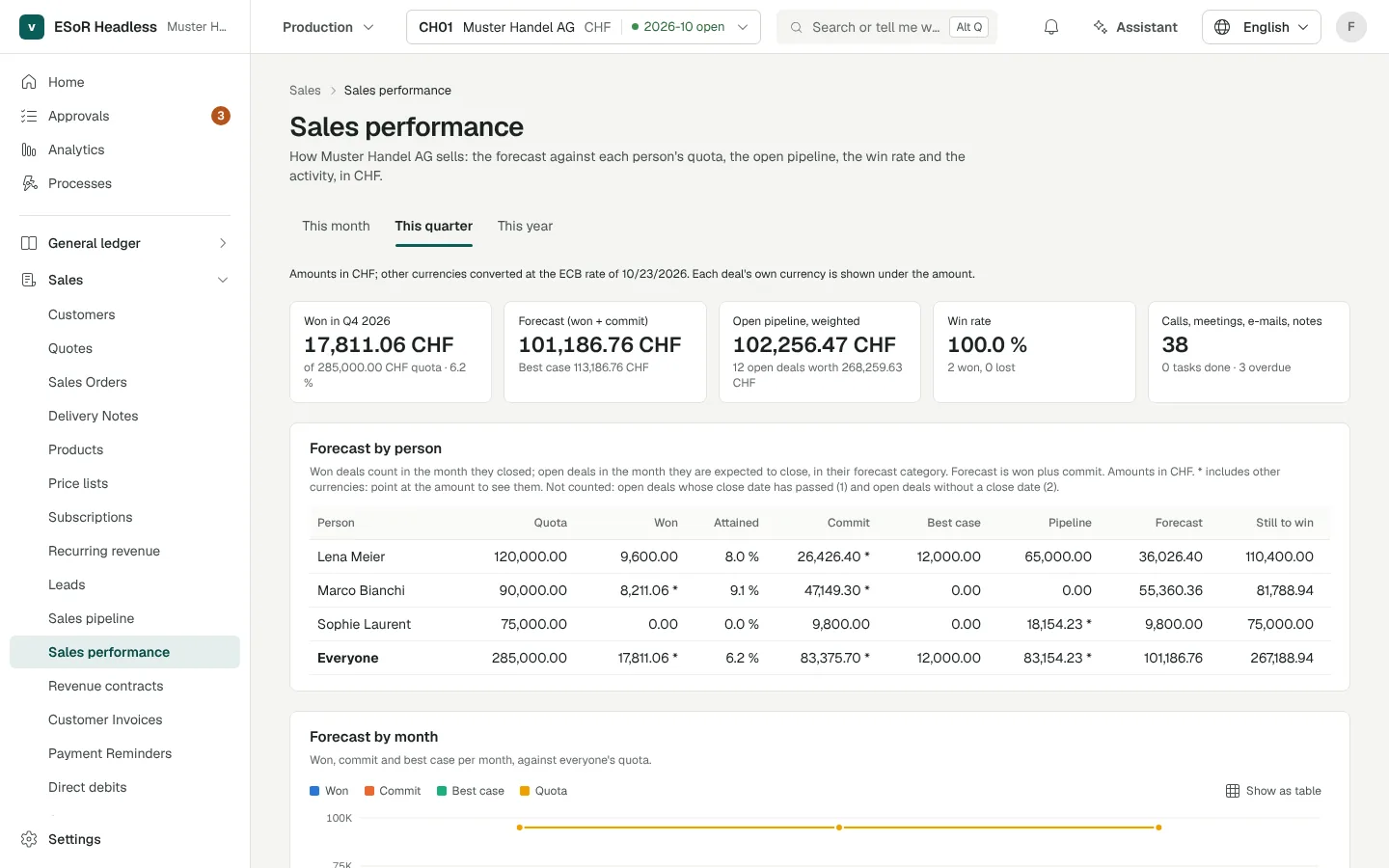
A fast web app for finance and sales teams on desktop, tablet and phone, in English, German, French, Italian and Swedish. An assistant is built in: ask a question, get the figures and a link to every step, or ask for a list in a sentence and keep it as a report on Home or in your inbox each week. Each company chooses its industry, and the app puts that industry's screens first.
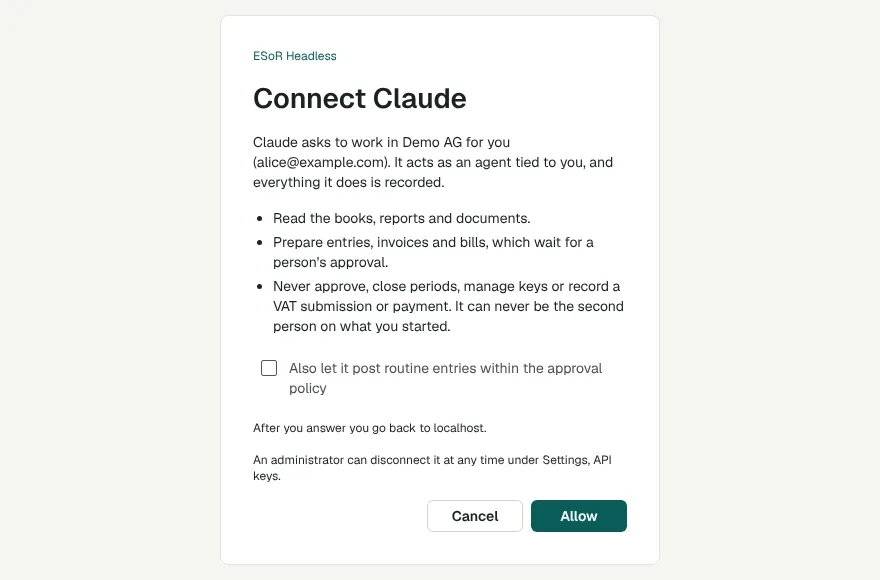
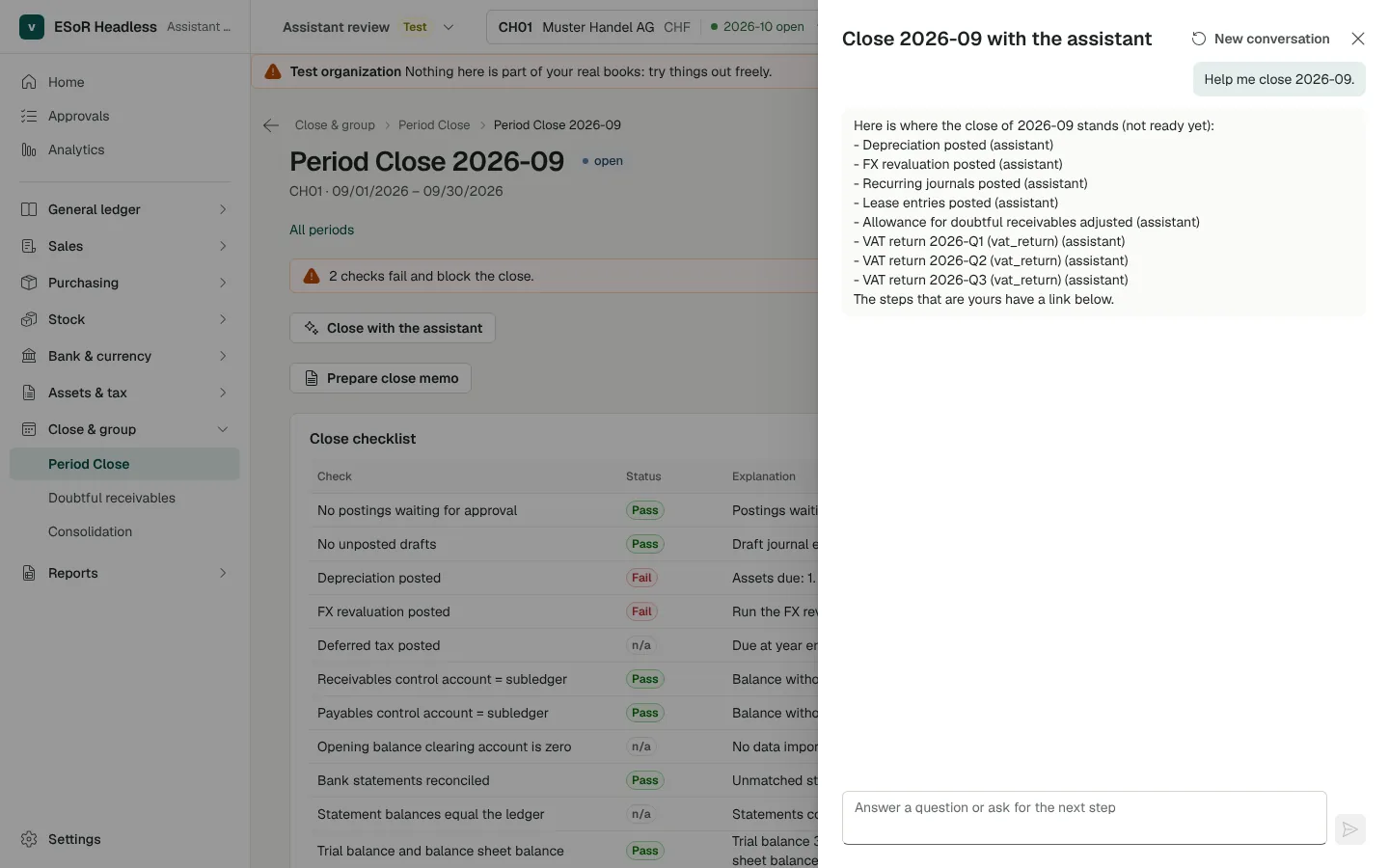
Connect Claude or ChatGPT in a minute. The assistant works the books with 230+ tools, from reports to drafting bills, quotes and the month-end close.
Headless from day one. Every screen is built on a public REST API with idempotent writes and Standard Webhooks across 19 domain events, so other systems can do anything a person can.
The system keeps business outcomes true by itself, like an outsourced back office, and leaves a person only the steps that are theirs. Switched on per company and per outcome.
Rules for everyoneRoles, approval policy, AI reviewer, posting limits, closed periods
System of recordLedger, sales, purchasing, bank, tax, close, CRM, support
05Autopilot
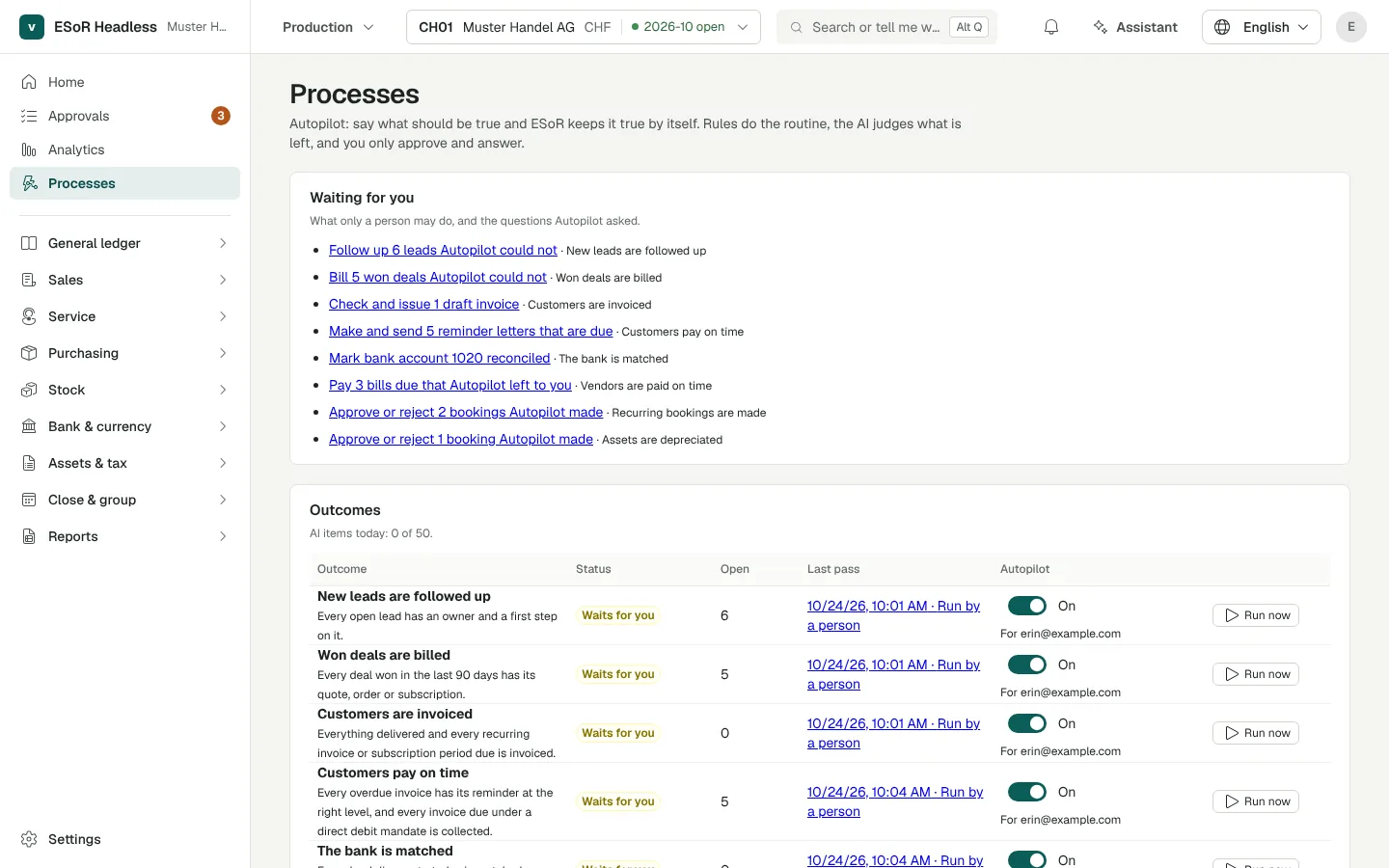
Nobody tells the system what to do next. Each outcome is a test it checks from its own records, such as “every bank line is matched”. Switched on, Autopilot keeps it true, and each pass follows the same five steps: code first, AI only where judgement is needed, people last.
The system finds what is not yet true, from its own records.
Code settles everything it can, the same way every time, at no AI cost.
Each leftover item, one at a time, with its own records and a few tools. It may ask one question instead of guessing.
An item counts as settled only when the system’s own check says so.
A short list of one-click steps and real questions, each a link to where it is done.
A pass runs when something happens (a bank statement arrives, a delivery is posted, a deal is won), once a day, and whenever someone presses Run now. The AI works on at most 50 items a company a day; the rest waits for the next day or a person.
06Talk to your data
Stabiso has its own MCP server today, with 230+ tools. A company connects the ChatGPT or Claude it already uses in a minute: the person signs in and allows it, and from then on they ask in their own words. The assistant works under that person’s rights, so it sees what they may see and nothing more, and every call is in the audit trail.
“Which deals should I call about this week?” The pipeline, the open leads, the follow-ups due and each customer’s history come back in one answer, and the call can be logged straight after.
“Show me the cash of every company as a chart.” The assistant reads each company’s cash and its 13-week forecast and draws them side by side; for a group, the consolidated balance sheet and cash flow.
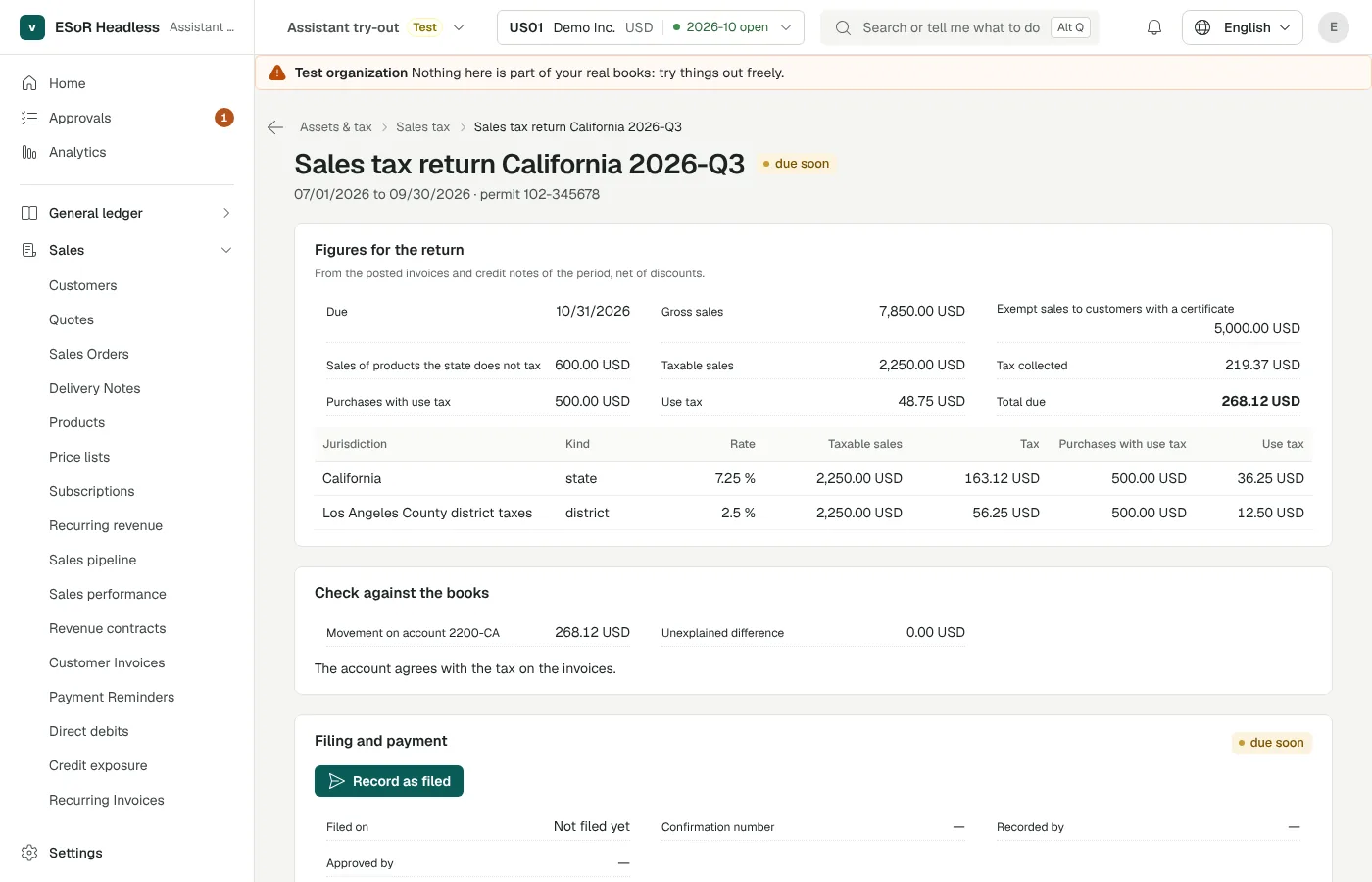
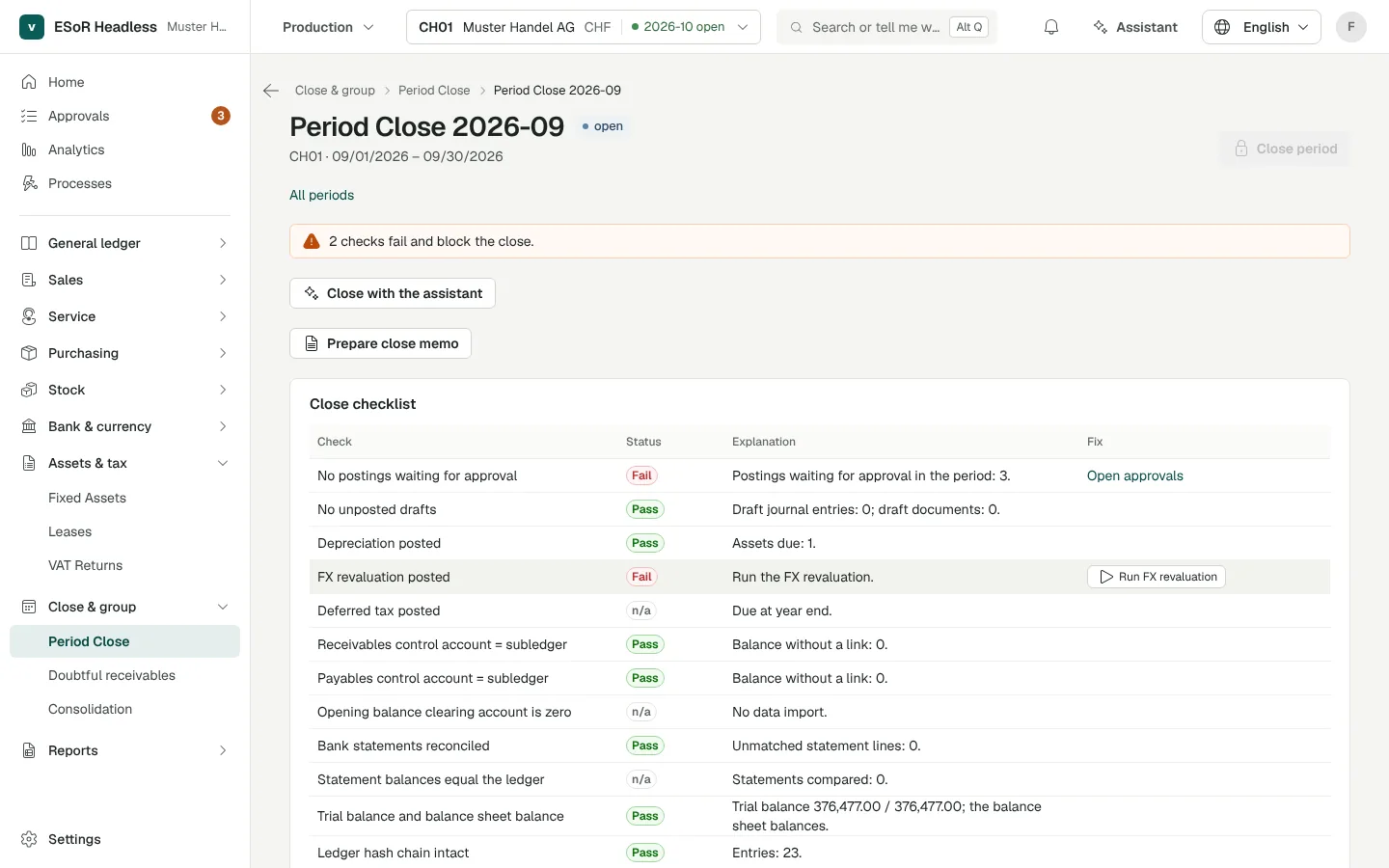
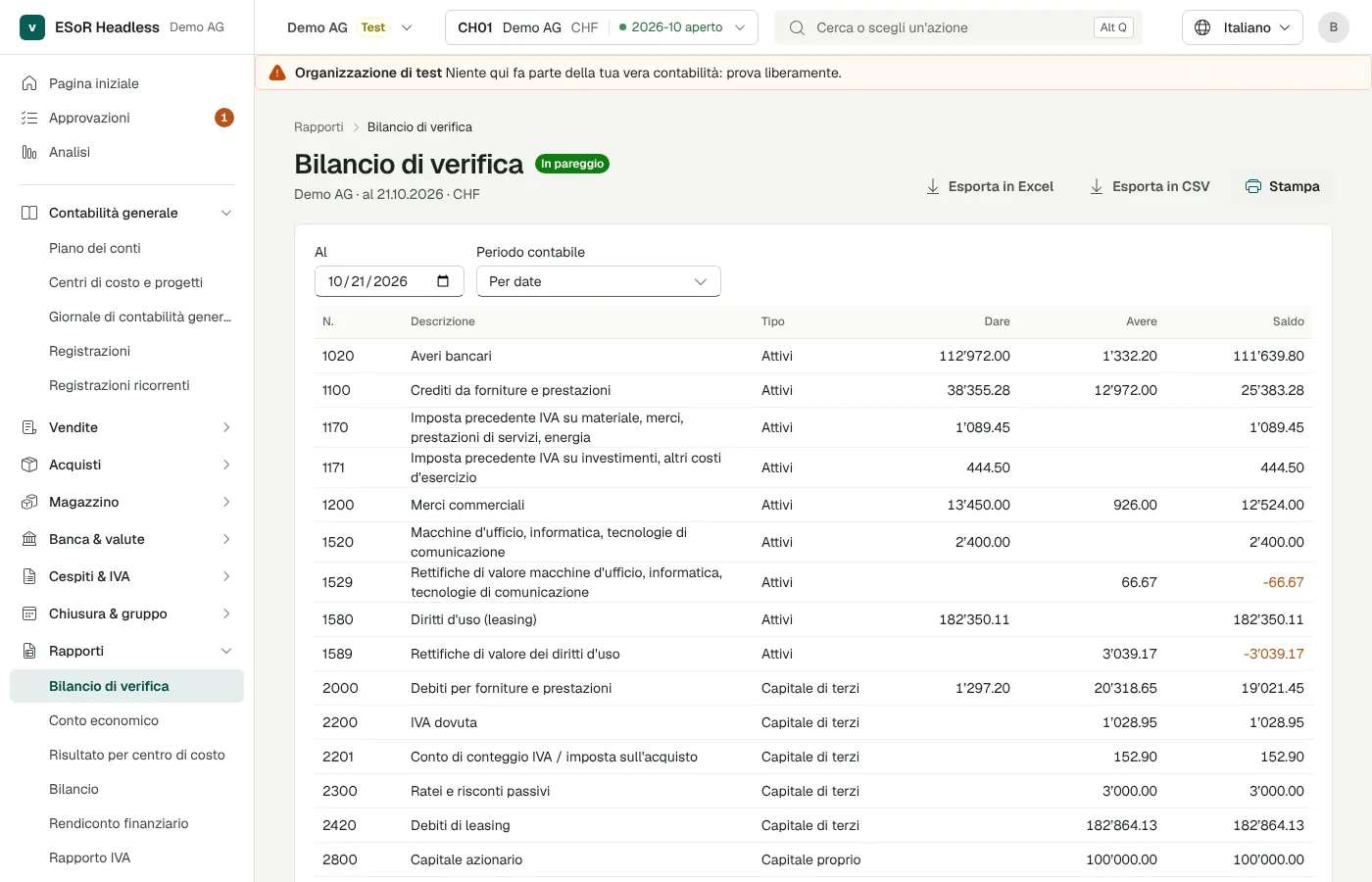
“The VAT report for last quarter.” The report comes back with every box opening the bookings behind it; the trial balance, the aging and the close checklist the same way.
External auditors get read-only access with an end date and may connect their own AI. They pull the reports and files they need without taking the team’s time, and every page and tool call they open is logged.
07What it covers
Intelligence is only as good as the records under it, so we built the whole system, not a layer on top of someone else’s. It runs today on demonstration companies, with every function below live.
08Countries
Tax rules and charts of accounts for each country are part of the product, not a consulting project. Returns are prepared and checked in the system; you submit them.
Charts of accounts: Swiss SME, German HGB, French PCG, Italian, Spanish PGC, Swedish BAS, Finnish, Danish, Norwegian NS 4102, IFRS, UK, US GAAP, Canada. App and documents in English, German, French, Italian and Swedish.
09Controls
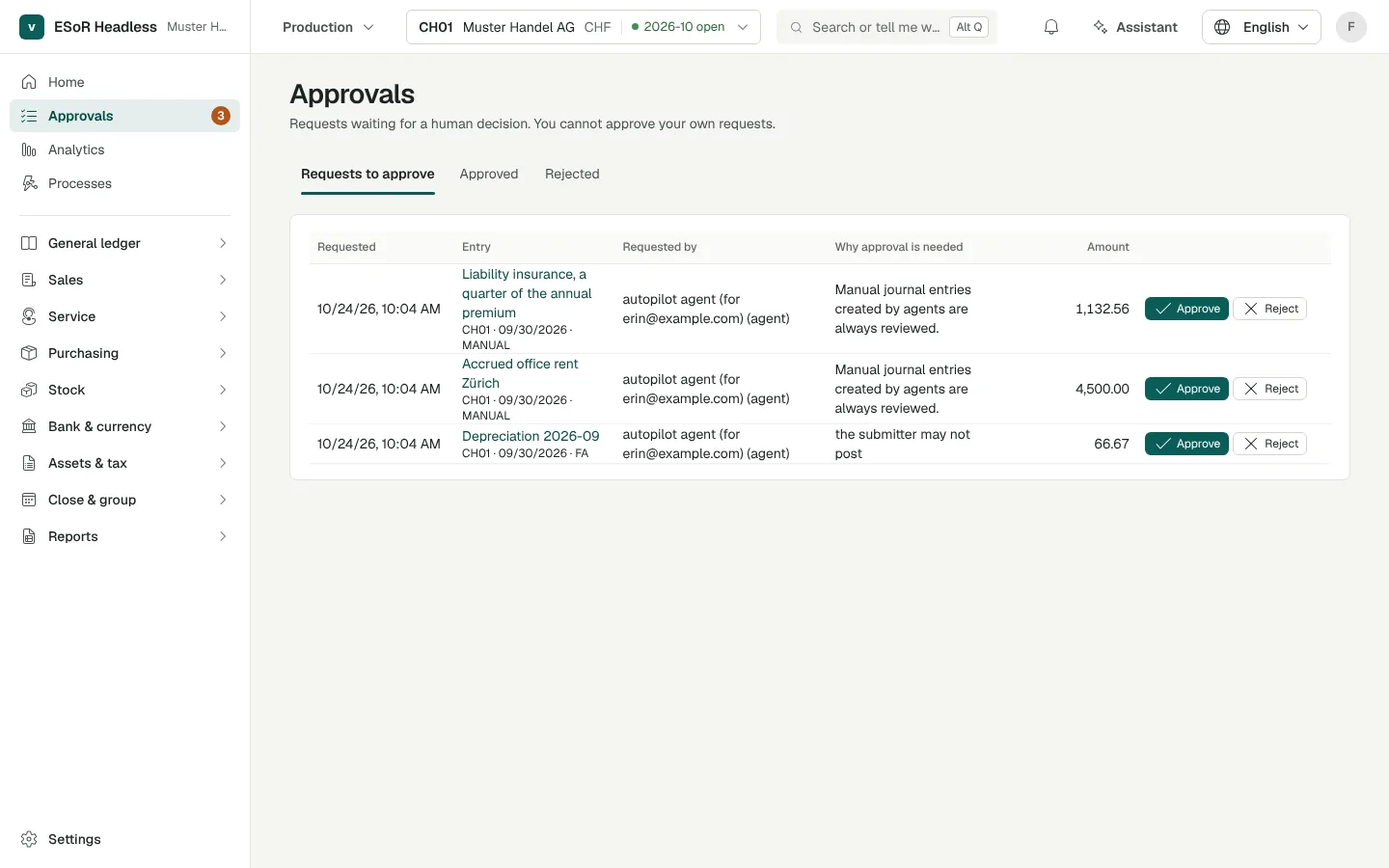
Autonomy is only useful if you can trust it. The AI reviewer runs fixed checks on a new customer or vendor—duplicates, VAT register, own bank accounts—on the entries of the period-end runs and on expenses, and clears what passes. What it holds waits for another person; an owner who runs the company alone releases it with a passkey touch, so a company of one is never blocked. An administrator switches to four-eyes mode when the law or auditor requires a second person.
Autopilot and assistants may
Only a person may
AI reviewer (default) or a second person
10Audit
A new system of record has to earn an auditor’s trust. Stabiso was designed for the audit from the start, not fitted for it later, so an audit can take days instead of weeks.
Posted entries are never edited, only reversed. Every entry is chained to the one before it, and anyone can recompute the chain to prove nothing was changed.
Each figure in a report or a tax return opens the entries behind it, and each entry the document, bank line or file it came from.
Every change records the person or agent, the values before and after, and the second person who approved it. Autopilot records what each pass saw, did and which tools it used.
Segregation of duties, posting limits and closed periods are rules the system refuses to break, so the auditor tests one rule instead of sampling thousands of postings for it.
The French FEC, the German GoBD data carrier and the OECD SAF-T in one click, an audit evidence pack after the AICPA Audit Data Standards in every country, and a complete archive of a company’s books and documents.
Invite an auditor with the date their access ends. They, and the AI assistant they connect, can read everything and change nothing, and every page and tool call they open is in an access log.
11Safe on Google Cloud
Stabiso was born on Google Cloud as an event-driven transactional engine with the intelligence embedded: every posting is one transaction in its database, and every change is an event that Autopilot, webhooks and the assistants act on. The services every system of record depends on, its hosting, database, backups, encryption and storage, are Google’s own, run in Google’s Zurich region, so we put our work into the system of record and not into running data centres.
For the infrastructure we rely on Google’s certifications and audit reports, not on our own: Google Cloud publishes its ISO/IEC 27001, 27017 and 27018 certificates and its SOC 1, 2 and 3 reports, and the application runs on Cloud Run under Google’s published 99.95% monthly availability.
What we add on top
12A look inside
13Be part of it
The best way to see what this changes is to run a company on it. The same system serves an owner with one company, an investor or a holding with many, and a provider that runs the back office for its clients: the outcomes, the controls and the evidence are the same whoever approves.
Put your own companies on one system of record. Each company keeps its own books, the group is consolidated with its intercompany, and one person can belong to several organizations and choose one at sign-in.
Skip the outsourcing step. The processes run inside your own system of record, your own people approve, and there is nothing to hand over to a new team.
Sell finished work instead of hours. The system prepares, your accountants approve and answer the questions, and every promise, such as “closed by working day 5”, is measured from the records.
How a firm starts
Set up the company, bring its opening balances, and switch on the outcomes where most of the hours go today, often the bank and the bills.
A test copy of the live books takes one click and never sends e-mails, payments or filings.
Every pass is recorded: what the rules settled, what the AI did, what was left for a person. The minutes a person spends per company per month come from the records, not from a promise.
Not there yet
One screen across all of a provider’s clients is still to be built: today each organization’s Processes page shows its own. Payroll is not part of Stabiso.
Stabiso is coming out of stealth, and runs today on demonstration companies. We are looking for investors who want to be part of it, and who could run their own firms on it, for owners who want their company to run on it, and for outsourcing providers and accounting firms who want to sell finished work instead of hours.